
Products · Discharge Stations
Controlled Discharge From IBC to Process
Connect Your IBC to the Next Stage With a Controlled, Contained Discharge
ISL Discharge Stations are designed to safely and hygienically discharge powders, granules and pellets from an ISL IBC into downstream processes such as mixing, packaging, screening and conveying.
As the IBC is lowered onto the station, its outlet engages with the station's sealing interface while the IBC Cone Valve locates onto the central probe. This creates a controlled connection between the IBC and downstream process.
Available in Standard and Basic configurations, the stations can be selected according to the level of discharge control, dosing and process integration required.

Standard Discharge Station
Position transducer · Batch & continuous feeding
Basic Discharge Station
Fixed central probe · Automatic discharge
What Does a Discharge Station Do?
From Stored Material to Controlled Process Flow
An IBC holds the material. The Discharge Station creates the connection between that IBC and the process that needs the material.
The station is designed to:
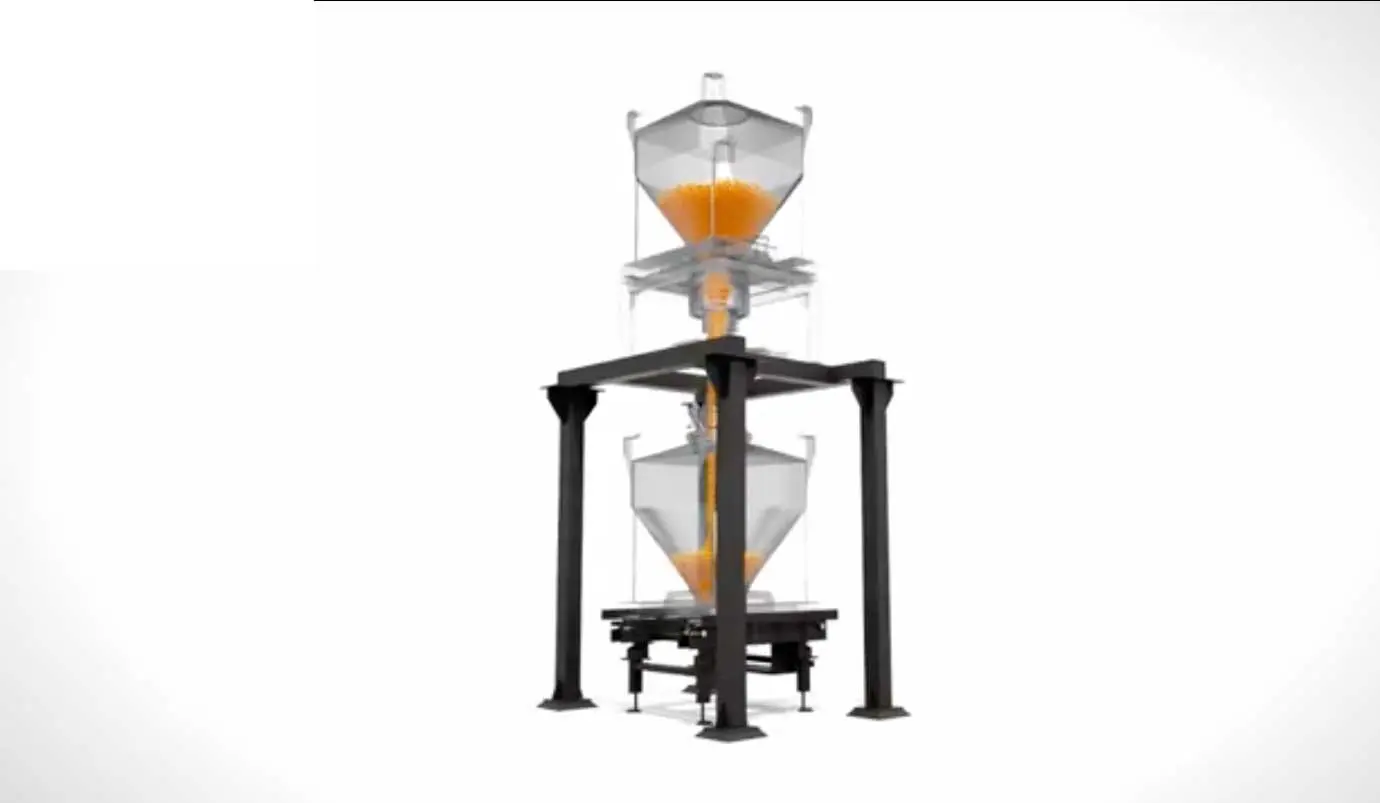

Position
Locate the IBC correctly over the discharge mechanism.

Seal
Create an environmental seal between the IBC and downstream process.

Discharge
Open the IBC Cone Valve to allow material to flow into the process.

Control
Depending on the configuration, control the valve aperture and material flow.

Transfer
Direct the discharged material into mixing, packaging, screening, conveying or other downstream processes.
Choose Your Discharge Station
Two Configurations for Different Process Requirements
 Standard Discharge Station
With Frame Vibrator & Mounting Frame
The Standard Discharge Station is designed for applications requiring controlled valve positioning and flow management.
A position transducer controls the Cone Valve aperture, allowing the station to maintain defined valve positions or continuous flow rates. This enables the station to function as an accurate batch and continuous gravimetric feeder when configured with the appropriate weighing system.

 Download Standard Discharge Station Datasheet
Key Capabilities
 Controlled valve aperture
- Position transducer
- Batch feeding
- Continuous feeding
- Gravimetric feeding
- Fail-safe valve operation
- Frame vibrator
- Optional load cells
- Environmental sealing
- Standard mounting frame
Standard vs Basic
Select the Right Level of Discharge Control
| Feature | Standard | Basic |
|---|---|---|
| IBC discharge | Yes | Yes |
| Environmental seal | Yes | Yes |
| Central probe | Yes | Fixed |
| Valve aperture control | Position transducer controlled | Fixed probe arrangement |
| Batch feeding | Yes |  No |
| Continuous feeding | Yes | No |
| Gravimetric feeding | Yes* | No |
| Frame vibrator | Yes | Yes |
| Mounting frame | Yes | Yes |
| Load cells | Optional | Optional |
| Flow sensor | Not Applicable | Optional |
| Roller limit switch | Yes | Optional |
| Typical downstream processes | Mixing, packaging, screening, conveying | Mixing, packaging, screening, conveying |
*Gravimetric feeding depends on the appropriate weighing/load-cell configuration. The comparison is based on the supplied Standard and Basic Discharge Station datasheets.
The Technology Behind Controlled Discharge
ISL Cone Valve + Discharge Station
The Discharge Station works together with the ISL IBC Cone Valve to create a controlled path between the IBC and the downstream process.
When the IBC is lowered:

The Cone Valve locates onto the station's probe, allowing the valve to operate within the discharge station.
In the Standard Station, a position transducer controls the valve aperture, allowing the opening to be maintained at different positions or used to achieve continuous flow rates.
How the Discharge Station Works
A Sealed Connection Before, During & After Discharge
Position the IBC
The IBC is lowered onto the Discharge Station.

Engage the Outlet
The IBC outlet engages with the station's sealing interface.

Locate the Cone Valve
The IBC Cone Valve locates onto the station's central probe.

Create the Seal
The connection between the IBC and process forms an environmental seal.

Open for Discharge
The Cone Valve creates the opening required for material to flow into the downstream process.
Control the Flow
On the Standard Station, the position transducer controls the valve aperture according to the required flow condition.

Empty the IBC
Material continues to discharge into the downstream process.

Lift the IBC
Once empty, the IBC is lifted from the station. The outlet remains sealed until shortly after the Cone Valve re-seats.
This arrangement is designed so there is no momentary product exposure before, during or after discharge.
Designed for Contained Material Transfer
Keep the Connection Controlled
Material transfer is not complete simply because the valve opens.
The interface between the IBC and process also needs to remain controlled while the material is being discharged.
The ISL Discharge Station uses the IBC outlet and station sealing arrangement to create an environmental seal.
As the IBC is lifted after discharge, the outlet remains sealed until the Cone Valve has re-seated inside the IBC outlet.
This is designed to prevent product exposure before, during and immediately after discharge.
Designed for Powders, Granules & Pellets
Handle Different Forms of Bulk Solids
The Discharge Station datasheets specify the equipment for:

Where Can the Material Go?
Connect the IBC to Your Downstream Process
ISL Discharge Stations are designed for discharge into processes such as:

Mixing
Transfer bulk materials from the IBC into a mixer.

Packaging
Provide a controlled discharge connection to packaging equipment.

Screening
Discharge material into screening processes.
Conveying
Connect the IBC discharge to conveying systems for movement to another process stage.
Standard Discharge Station
When Flow Control & Dosing Matter
The Standard Discharge Station adds active control over the IBC Cone Valve aperture.
Basic Discharge Station
Straightforward IBC Discharge
The Basic Discharge Station is designed for applications where the primary requirement is reliable discharge from the IBC into the downstream process.
The IBC Cone Valve locates onto the station's fixed central probe.
As the IBC is lowered into position, the valve remains located on the probe, creating an annular gap through which material can flow.
Frame Vibrator
Support Material Flow When Required
Both Standard and Basic Discharge Stations can be supplied with a frame vibrator.
The datasheets specify a piston vibrator with:
- Air pressure: 4 bar
- Air volume: 100 L/min continuous
- Tubing size: 12 mm
The vibrator provides an additional mechanical aid within the discharge station arrangement where material flow support is required.
Built-In Sensing & Control Options
Add the Feedback Your Process Requires
Mounting & Process Connection
Designed to Connect With Your Existing Process
ISL offers a standard mounting frame for both Discharge Station configurations.
The mounting frame can be customized to suit client requirements.

Construction & Materials
Specified for Process Applications
Both Discharge Station configurations specify stainless steel and polymer components for the material-contact areas.
Note: The food-grade/FDA-compliant specification refers to the listed elastomers in the datasheets and should not be interpreted as a certification claim for the complete Discharge Station.
Complete IBC Discharge Arrangement
From IBC to Your Process
The Discharge Station becomes the connection point between the IBC and the next stage of production. A typical arrangement can be represented as:
The wider system can also incorporate:
- IBC filling
- Material storage
- Weighing
- Batching
- Blending
- Controlled discharge
- Dosing
- Conveying
- Downstream processing
This allows the Discharge Station to function as part of a complete bulk solids handling system rather than as a standalone component.
Technical Specifications
Standard & Basic Discharge Stations
Standard Discharge Station
- Application
- IBC discharge to mixing, packaging, screening & conveying
- Material
- Powder, granules & pellets
- Mounting frame
- Standard, customizable
- Discharge connection
- 204 mm OD pipe with 5 mm flare
- Lift height sensor
- Ultrasonic, 10–30 VDC, 4–20 mA
- Roller limit switch
- Adjustable roller lever, SPDT, IP65
- Dump valve
- Double acting, single rod pneumatic cylinder
- Frame vibrator
- Piston vibrator
- Vibrator pressure
- 4 bar
- Vibrator air volume
- 100 L/min continuous
- Pneumatic requirement
- 4–6 bar
- Pneumatic air volume
- 2 m³/min
- Tubing
- 12 mm
- Optional load cells
- SS shear beam, up to 5 tonnes
- Dimensions
- 1225 × 1225 × 772 mm
- Approx. net weight
- 250 kg
Basic Discharge Station
- Application
- IBC discharge to mixing, packaging, screening & conveying
- Material
- Powder, granules & pellets
- Mounting frame
- Standard, customizable
- Discharge connection
- 200 mm ID, 125/150# ANSI bolt hole
- Frame vibrator
- Piston vibrator
- Vibrator pressure
- 4 bar
- Vibrator air volume
- 100 L/min continuous
- Tubing
- 12 mm
- Roller limit switch
- Optional
- Level sensor
- Optional capacitive sensor
- Dimensions
- 1225 × 1225 × 772 mm
- Approx. net weight
- 220 kg
Which Discharge Station Is Right for You?
Start With the Process Requirement
Designed Around Your Installation
Standard Technology. Configurable Integration.
ISL provides standard Discharge Station configurations while allowing certain installation parameters to be adapted.
The datasheets specifically identify customization possibilities for:
This allows the station to be considered around your existing equipment and facility layout.
Frequently Asked Questions
An IBC Discharge Station is the interface between an IBC and the downstream process. It allows material stored in the IBC to be discharged into processes such as mixing, packaging, screening and conveying.
The datasheets specify the stations for powders, granules and pellets.
The Standard Station incorporates a position transducer to control the Cone Valve aperture and can support batch and continuous gravimetric feeding when appropriately configured. The Basic Station uses a fixed central probe arrangement to create an annular discharge gap when the IBC is lowered onto the station.
The datasheets describe an environmental seal between the IBC and process. During lift-off, the IBC outlet remains sealed until just after the valve re-seats.
Yes. Its position transducer controls the valve aperture and can maintain defined valve positions or continuous flow rates.
Yes. The datasheet describes the Standard Station as an accurate batch and continuous gravimetric feeder, with optional stainless steel shear beam load cells available up to 5 tonnes.
The datasheet states that the Basic Station automatically discharges product as the IBC is lowered onto it.
Yes. Both the Standard and Basic configurations in the supplied datasheets are specified with a frame vibrator and mounting frame.
The datasheets specify a piston vibrator operating at 4 bar, with 100 L/min continuous air volume and 12 mm tubing.
For the Standard Station, stainless steel shear beam load cells are available as an optional configuration, with weighing capacity up to 5 tonnes.
Yes. ISL offers a standard mounting frame, and the datasheets state that it can be customized to suit client requirements.
The datasheets specifically identify mixing, packaging, screening and conveying.
The mounting frame and process connection can be customized according to client requirements, allowing the station to be considered around the downstream process interface.
The supplied datasheets list Food, Pharma, Chemical & Others.
Choose the Standard configuration when you need active valve aperture control, batch/continuous feeding or gravimetric feeding. Choose the Basic configuration when a straightforward fixed-probe discharge arrangement is sufficient.
Control the Connection Between Your IBC & Process
Whether you need straightforward IBC discharge or controlled batch and continuous feeding, ISL Technologies provides Discharge Station configurations designed to connect your IBC with the next stage of production.
Let's Engineer Your Discharge System
 Download Discharge Station Datasheets